Battery Health Unpacked: What UK Used EV Buyers Need to Know About Certificates & Warranties
The electric revolution is in full swing, and for many UK motorists, a used EV represents the most accessible way to join the zero-emission movement. But unlike traditional petrol or diesel cars where the engine's health is the primary concern, buying a used electric vehicle shifts the focus squarely onto its most vital and expensive component: the battery.
The battery is the beating heart of an EV, dictating its range, performance, and ultimately, its long-term value. Naturally, it’s also where most concerns for used EV buyers lie. Will it still go the distance? How much life is left in it? And what happens if it fails? Understanding battery health certificates, manufacturer warranties, and the factors affecting degradation is absolutely crucial. This guide from CarsLink.ai will equip you with the knowledge to navigate the used EV market with confidence, ensuring your next electric purchase is a smart one.
The Heart of the Matter: Why Battery Health Dominates Used EV Concerns
When you're considering a used electric vehicle, the state of its battery isn't just a minor detail – it's the defining characteristic that will impact your ownership experience in several fundamental ways.
Firstly, there's the very real impact on range and usability. An EV battery, like any rechargeable battery, will gradually degrade over time, losing some of its original capacity. This phenomenon, known as 'degradation', means that a car originally rated for 200 miles might only achieve 160 miles after several years if its battery capacity has dropped to 80% of its original state. For daily commutes, this might be manageable, but for longer journeys or those who push the limits of their vehicle's range, this reduction can be significant. It directly affects the 'range reality' of owning that specific car, potentially leading to increased charging frequency or making certain trips unfeasible without an extra top-up.
Secondly, while less immediately noticeable than range, severe battery degradation can subtly affect performance and charging speeds. The battery's ability to deliver and accept power can diminish, potentially leading to slightly slower acceleration or a reduced rapid charging rate.
Finally, and perhaps most importantly for your wallet, is the prohibitive cost of battery replacement. Unlike a worn-out engine that can often be rebuilt or replaced with a reconditioned unit for a few thousand pounds, an EV battery pack can cost tens of thousands – often rivalling or exceeding the value of the used car itself. This makes due diligence on battery health paramount, as you don't want to inadvertently purchase a vehicle nearing a point where a costly battery intervention becomes necessary. A healthy battery not only ensures a better ownership experience but also protects the car's resale value down the line.
Unpacking the Battery Health Certificate (BHC)
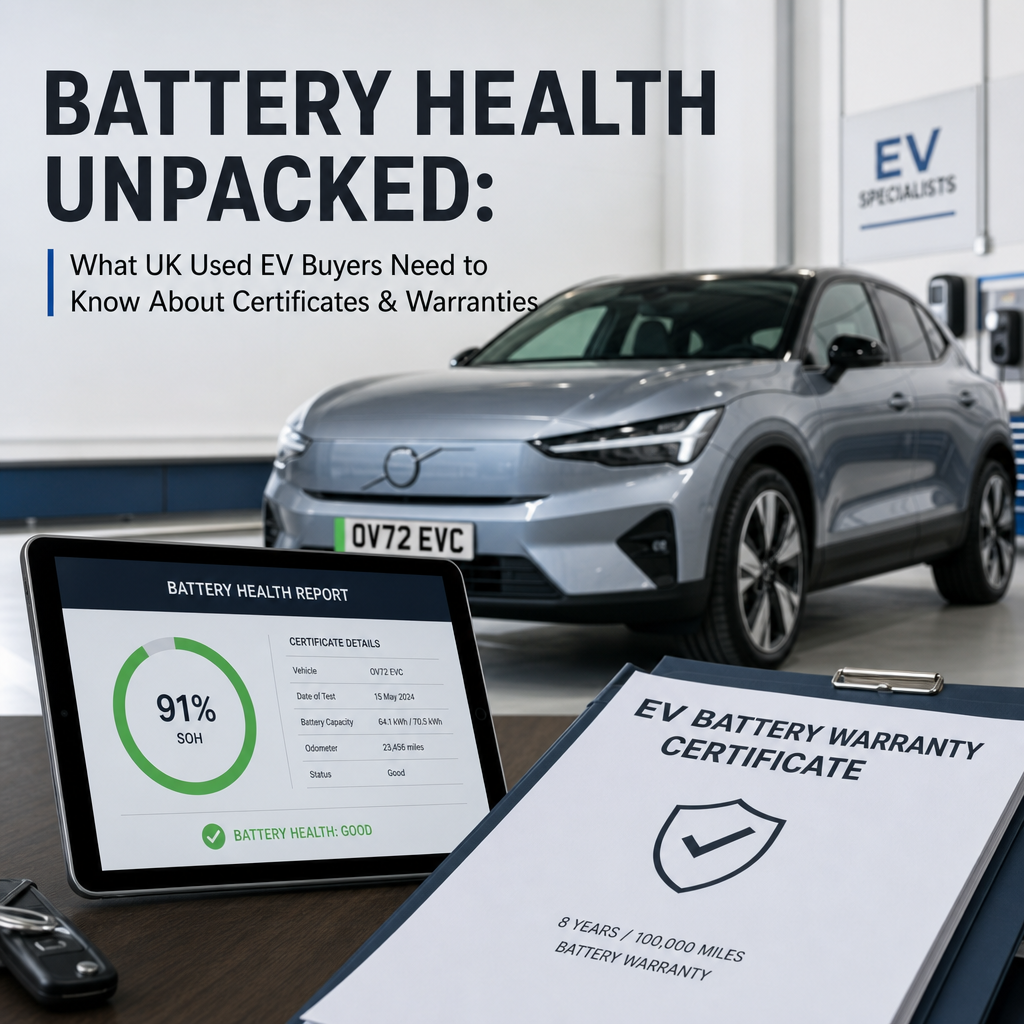
A Battery Health Certificate (BHC) is perhaps the most valuable document you can obtain when buying a used EV. Think of it as the equivalent of a comprehensive service history for a traditional car, but specifically focused on the component that matters most for an EV.
What is a BHC? A BHC is an official document that provides an objective assessment of an EV battery's current "State of Health" (SoH). This is typically expressed as a percentage, indicating how much of its original energy capacity the battery retains. For example, a BHC showing 90% SoH means the battery can store and deliver 90% of the energy it could when it was new. The certificate might also include information like estimated current range, a diagnostic report of any error codes, and details about the battery's operating temperatures.
Who issues them and how to get one?
- Manufacturer-Approved Workshops/Dealerships: This is the gold standard. Many main dealers for brands like Nissan, BMW, Tesla, and Hyundai can perform a diagnostic test and issue an official BHC. Often, approved used EVs sold through main dealers will come with one as standard.
- Third-Party Specialists: A growing number of independent EV specialists and diagnostic companies offer battery health checks and certificates. Companies like Altelium in the UK provide robust, data-driven battery health reports.
- In-Car Diagnostics: Some newer EVs display a basic SoH estimate within their infotainment system, but this is generally not considered a formal certificate.
When buying, always ask the seller for a recent BHC. If they don't have one, ask if they would be willing to obtain one from a main dealer or reputable specialist. You might consider offering to split the cost, as it benefits both parties. For the more technically inclined, certain advanced OBD-II scanners combined with EV-specific apps (e.g., LeafSpy for Nissan Leaf owners) can read battery SoH, but these provide information rather than a certified document.
What to look for on a BHC:
- SoH Percentage: Generally, aim for 85% or above for a good used EV. Anything below 80% could indicate significant degradation and might start to impact the car's usability or even warranty coverage.
- Date of Certificate: Ensure it's recent – ideally within the last few months. Battery health can change over time.
- Issuing Body: A certificate from a main dealer or a well-known independent specialist carries more weight.
Manufacturer Warranties: Your Safety Net
While a BHC tells you the current state of the battery, the manufacturer's warranty is your crucial safety net against unforeseen, significant degradation or outright failure. This is where you find peace of mind for the long haul.
Typical Coverage: Most EV manufacturers offer a separate, extended warranty specifically for the high-voltage battery. This is usually 8 years or 100,000 miles, whichever comes first. However, some brands vary:
- MG: 7 years/80,000 miles
- Tesla: For their standard and long-range models, it's 8 years or 120,000 miles; for Performance models, it's 8 years or 150,000 miles.
- Kia/Hyundai: Often 8 years/100,000 miles, sometimes with longer options on newer models.
Crucially, these warranties almost always include a degradation threshold. This means the battery is covered if its capacity drops below a certain percentage of its original capacity within the warranty period. This threshold is typically 70% or 75%. So, if your car's battery capacity falls below 70% within 8 years/100,000 miles, the manufacturer is obliged to repair or replace it (often with a reconditioned battery of similar age and mileage, or a new one, at their discretion). Beyond degradation, the warranty also covers manufacturing defects and material faults.
What's NOT typically covered: It's important to understand the limitations. The warranty generally does not cover:
- Normal wear and tear/degradation that stays above the specified threshold (e.g., if it's at 78% after 7 years, it's considered normal).
- Damage from accidents, floods, or misuse.
- Damage from improper charging (e.g., using unapproved charging equipment).
- Unauthorised repairs or modifications to the battery pack.
Transferability: The excellent news for used EV buyers is that manufacturer battery warranties are almost always transferable to subsequent owners. This is a massive advantage over some aftermarket warranties or private deals. To confirm the remaining warranty on a specific vehicle, obtain the VIN (Vehicle Identification Number) from the seller and contact a main dealership for that brand. They can check the car's history and confirm the exact warranty expiry date and terms.
Proactive Checks: Understanding Degradation & What to Ask the Seller
While BHCs and warranties provide formal assurances, understanding the factors that affect battery degradation and asking the right questions can give you invaluable insights into a car's history and likely future performance.
Factors Affecting Battery Degradation:
- Temperature Extremes: EV batteries dislike being too hot or too cold, especially when charging rapidly. Cars frequently operated or parked in very hot climates, or those undergoing repeated rapid charging in cold weather, can show accelerated degradation. Older EVs without active thermal management systems (like the early Nissan Leaf, which was air-cooled) are particularly susceptible to heat-related degradation. Newer EVs almost universally feature sophisticated liquid cooling systems to maintain optimal battery temperatures.
- Charging Habits: While rapid charging is convenient, frequent, exclusive reliance on DC rapid charging, especially to 100%, can be harder on the battery than slower AC charging. Similarly, consistently charging to 100% and leaving it parked for extended periods, or regularly discharging the battery to very low levels (below 10-20%), can contribute to stress. Modern Battery Management Systems (BMS) mitigate much of this, but careful habits still help.
- Mileage and Age: This is a straightforward correlation – older cars with higher mileage will naturally have experienced more charge cycles and therefore are more likely to exhibit some degradation.
- Driving Style: While less significant than temperature or charging, extremely aggressive driving (frequent hard acceleration and braking) can generate more heat and energy flow, potentially contributing to very long-term degradation.
Key Questions to Ask the Seller: Beyond requesting a BHC and checking the warranty, these questions can help paint a clearer picture:
- "Do you have a recent Battery Health Certificate?" (Always start here.)
- "What's the car's typical real-world range now, compared to when you bought it?" This provides an anecdotal but useful benchmark.
- "How often did you use rapid chargers, and what was your usual charging routine (e.g., charging to 80% at home)?" Look for sensible, varied charging habits.
- "Has the car generally been parked in a garage or outdoors in extreme temperatures?" A garage-parked car typically experiences less temperature stress.
- "Can you show me the battery health indicator in the car's infotainment system (if available)?" Many EVs provide an in-car estimate.
- "Has the battery ever been replaced or worked on?" While highly unlikely, it's a critical question.
- "What's the VIN? I'd like to check the remaining manufacturer warranty."
Conclusion
Buying a used electric vehicle in the UK is a smart and increasingly popular choice, offering environmental benefits and lower running costs. However, it demands a different kind of due diligence compared to traditional cars. By understanding the importance of battery health, demanding a current Battery Health Certificate, verifying the remaining manufacturer's warranty, and asking the right questions about the car's history and charging habits, you can significantly de-risk your purchase.
Armed with this knowledge, you can confidently evaluate used EVs and ensure you're investing in a vehicle whose heart – its battery – is in robust health, ready to deliver miles of reliable, emission-free driving. At CarsLink.ai, we believe in empowering UK buyers, and with these tools at your disposal, your next used EV purchase will be an informed and satisfying one.