Choosing Your Workhorse: A UK Buyer's Guide to Used Van Load Space and Dimensions
For any UK tradesperson, delivery driver, or small business owner, a van isn't just a vehicle; it's the beating heart of their operations. It's their mobile workshop, their stockroom, and their key to getting the job done. Yet, buying a used van can feel like a minefield, especially when trying to decipher manufacturer specifications and visualise how your precious tools or goods will actually fit.
At CarsLink.ai, we understand that getting the right load space is paramount. Too small, and you're making extra trips or leaving vital gear behind. Too big, and you're burning unnecessary fuel, struggling with parking, and potentially paying more in road tax and insurance. This guide will walk you through the critical aspects of used van load space and dimensions, helping you find the perfect mobile partner for your business.
Decoding Van Sizes: Small, Medium, Large & Their Real-World Uses
Van manufacturers categorise their models, but understanding what these classifications mean in practical terms is key. Let's break down the common sizes you'll encounter on the used market:
Small Vans (Compact Loaders):
- Examples: Ford Transit Connect, Vauxhall Combo, Citroën Berlingo, Peugeot Partner, Fiat Doblò, Volkswagen Caddy.
- Typical Load Volume: 2.0 to 4.0 cubic metres (m³).
- Real-World Use: These nimble vehicles are perfect for urban environments and sole traders. Think electricians carrying tools and a few boxes of parts, plumbers with pipes and fittings, or florists transporting arrangements. They're often car-like to drive, easy to park on busy streets, and generally more fuel-efficient. Their compact dimensions make them ideal for quick dashes across town, though their limited internal length and height mean very long ladders or stacked pallets are usually out of the question. Many small vans, like the Transit Connect and Berlingo/Partner, also offer through-load hatches for items slightly longer than the load bay.
Medium Vans (Mid-Sized Multitaskers):
- Examples: Ford Transit Custom, Volkswagen Transporter, Vauxhall Vivaro, Renault Trafic, Mercedes-Benz Vito, Toyota Proace.
- Typical Load Volume: 5.0 to 9.0 m³.
- Real-World Use: This segment is the sweet spot for many UK businesses, offering a superb balance of capacity and manoeuvrability. Joiners, painters, small couriers, and general builders often gravitate here. Available in various wheelbases (L1, L2) and roof heights (H1, H2), a medium van can comfortably carry sheets of plywood (2440mm x 1220mm) flat on the floor in longer wheelbase versions. Most can accommodate at least one Euro pallet (1200mm x 800mm) width-wise between the wheel arches, and sometimes two length-wise. The Ford Transit Custom is particularly popular for its car-like driving dynamics and practical load space, including a useful load-through bulkhead.
Large Vans (Heavy-Duty Haulers):
- Examples: Ford Transit (full-size), Mercedes-Benz Sprinter, Volkswagen Crafter, Fiat Ducato, Peugeot Boxer, Citroën Relay, Vauxhall Movano.
- Typical Load Volume: 9.0 to 17.0 m³+.
- Real-World Use: When volume and payload are your absolute priority, a large van is the answer. These are the workhorses for large-scale removals, furniture delivery, large parcel networks, or businesses requiring a mobile workshop with extensive racking. Available in multiple wheelbase and roof height configurations (L1-L4, H1-H3), you can find versions capable of carrying multiple UK pallets (1200mm x 1000mm) or standing full-height wardrobes. While less nimble in tight spaces and generally less fuel-efficient, their sheer capacity makes them indispensable for heavy-duty applications. Be mindful of their gross vehicle weight (GVW), as some larger models might require a Category C1 driving licence, depending on when your licence was issued.
The Nitty-Gritty: Key Internal Dimensions Explained
Manufacturer brochures are full of numbers, but knowing what they represent for your specific needs is crucial.
Load Length (L): This is the distance from the bulkhead (the partition between the cabin and load bay) to the rear doors. This dimension dictates how long an item you can carry. For instance, if you regularly transport standard timber lengths (e.g., 2.4m, 3.6m), you need a van with sufficient load length. Don't forget to factor in any through-load hatches (also known as load-through bulkheads) which allow items like pipes or ladders to extend into a space under the passenger seat, significantly increasing effective load length in many medium and some small vans.
Load Width (W): Measured at two points:
- Maximum Width (above wheel arches): This is the widest point in the load bay, usually higher up.
- Width Between Wheel Arches: This is often the most critical dimension, especially if you carry pallets. A standard UK pallet measures 1200mm x 1000mm, and a Euro pallet is 1200mm x 800mm. Many medium vans can fit a Euro pallet between the arches width-wise (800mm dimension across), but a UK pallet is generally too wide. Large vans, however, are often designed to accommodate UK pallets between their arches, and multiple length-wise or width-wise depending on the model and configuration.
Load Height (H): This is the distance from the load floor to the highest point of the roof lining. This is vital for tall items like refrigerators, washing machines, or stacked boxes. Vans often come in various roof heights (e.g., H1 for standard, H2 for medium, H3 for high). Bear in mind that any internal racking, lining, or roof lights will slightly reduce this usable height.
Practical Tips for Measuring and Visualising Usable Load Capacity
Manufacturer figures are a great starting point, but they rarely tell the whole story. Here's how to get a realistic understanding of a used van's capacity:
- Don't Rely Solely on Brochures: Manufacturer load volumes are typically quoted for an empty, unlined van. Any internal ply-lining, racking, or aftermarket bulkheads will reduce the actual usable space.
- Measure Your Gear: Before you even start looking, accurately measure your most frequently carried items – your longest ladder, your biggest toolbox, the dimensions of your standard delivery boxes, or the largest piece of equipment you own. This gives you concrete figures to work with.
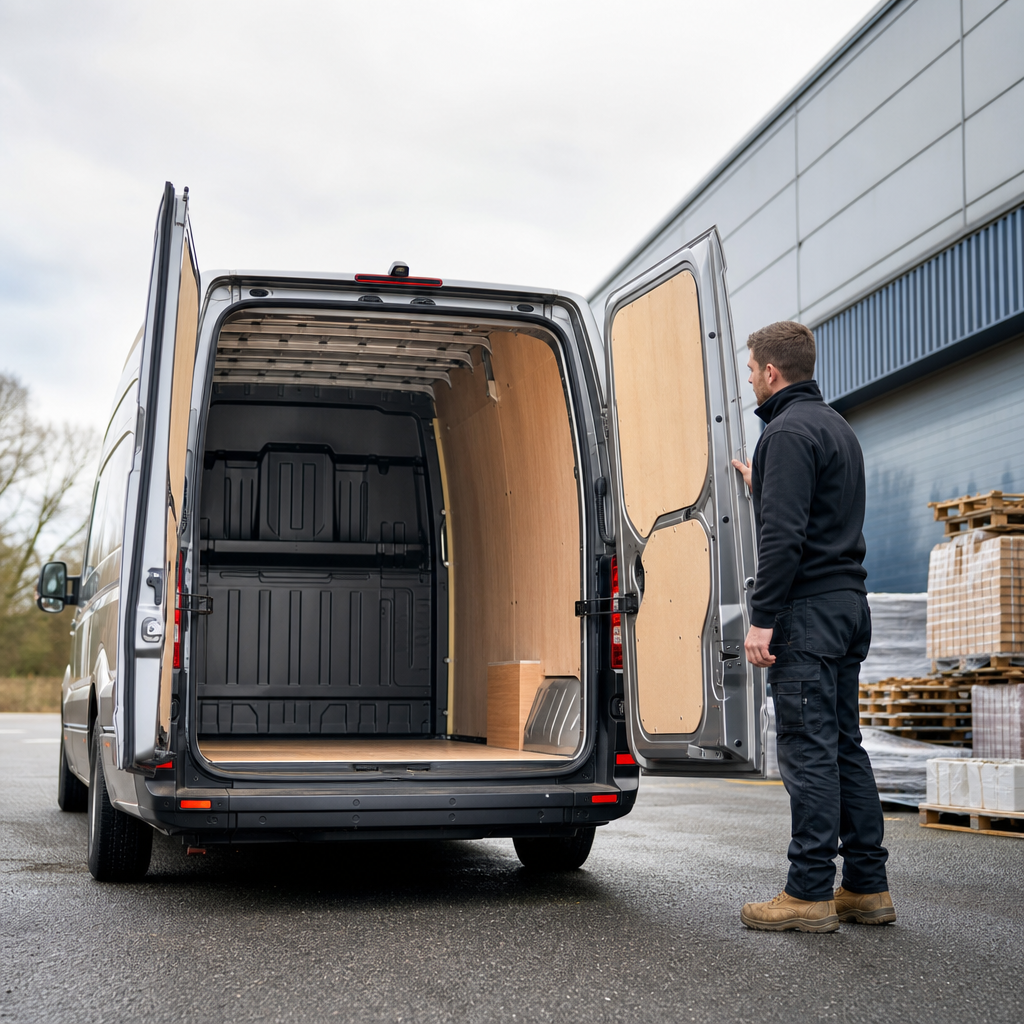
- Bring a Tape Measure: When viewing a used van, always bring your own tape measure (a laser measure is even better!). Don't be shy; open the rear doors and side loading door and measure:
- Load length (bulkhead to rear doors).
- Width between wheel arches.
- Maximum width above wheel arches.
- Load height (floor to roof).
- Rear door opening width and height.
- Side loading door opening width and height.
- Create Mock-Ups: If you're unsure if a particular item will fit, create a cardboard cut-out of its base or mark out its footprint on the floor. This can help you visualise how it will sit within the van's load bay.
- Consider Access, Not Just Space: Can you easily get your items into the van? A wide load bay is useless if the side loading door is too narrow, or the rear door aperture is too low for your tall items. Will you need a ramp, or even a tail lift for heavier goods (more common on larger vans)?
- Think Future-Proofing: Is your business likely to grow? Will you be carrying different or larger items in the next few years? Buying a van that offers a little more capacity than you currently need can save you from a costly upgrade sooner than expected.
- Account for Internal Fittings: Look closely at any existing racking or shelving. While these can be incredibly useful, they also consume valuable load space. If you plan to install your own bespoke system, ensure there's enough room for both your items and the racking itself.
Matching the Van to Your Business: A Tailored Approach
Choosing your workhorse is a highly personal decision driven by your unique business needs.
- List Your Essentials: Make an exhaustive list of every tool, piece of equipment, or type of goods you absolutely must carry on a daily basis. Prioritise these. Do you need to carry a full-size fridge? Or just a set of screwdrivers and a drill?
- Volume vs. Weight: Understand if your business is typically constrained by volume (e.g., a flower delivery service) or weight (e.g., a scrap metal collector). While this guide focuses on dimensions, payload capacity is another critical factor to research once you've narrowed down your size requirements. Many small vans will hit their payload limit before running out of space, while large vans are often the reverse.
- Driving Environment: If you spend most of your time in city centres, battling congestion and tight streets, a small or medium van will be far more practical and less stressful to drive and park. If you're frequently on motorways and have ample parking, a larger van might be more comfortable and efficient for your needs.
- Security: How valuable are your goods or tools? A solid, unglazed bulkhead offers maximum security and noise reduction. Consider where you'll store items when not in use.
- Your Image: For many businesses, a van is a mobile billboard. A well-chosen, appropriately sized van projects professionalism and efficiency.
Conclusion
Selecting the right used van is a significant investment in your business's efficiency and future. While mileage, service history, and engine condition are all important, getting the load space and dimensions right is arguably the most fundamental decision. By meticulously assessing your needs, understanding the various van sizes, and diligently measuring internal dimensions, you can avoid costly mistakes and find a workhorse that perfectly complements your operations.
Don't rush the decision. Take your time, bring your tape measure, and visualise your gear in the load bay. A well-chosen van won't just move your goods; it'll move your business forward. Head over to CarsLink.ai today to start exploring the fantastic range of used vans available across the UK!