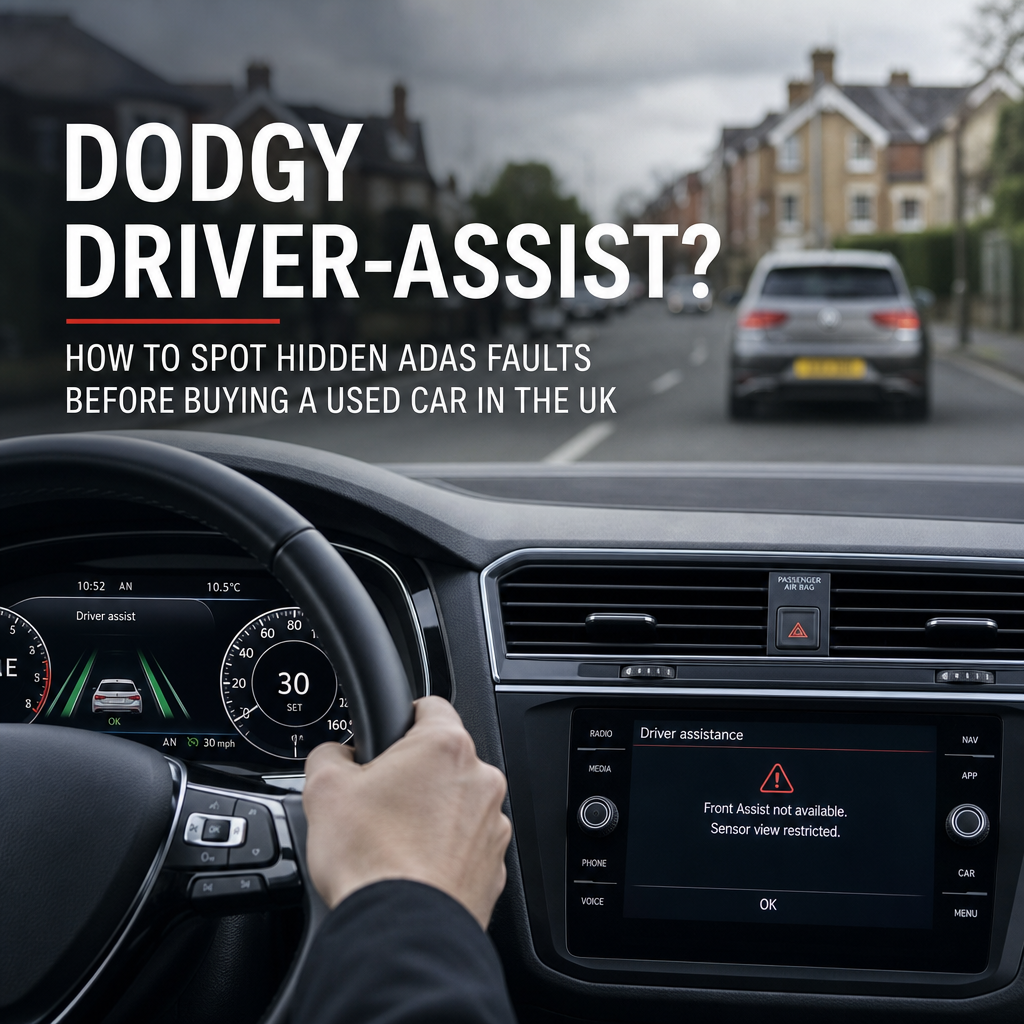
Dodgy Driver-Assist? How to Spot Hidden ADAS Faults Before Buying a Used Car in the UK
Advanced Driver-Assistance Systems, or ADAS, have rapidly become commonplace in modern vehicles. From adaptive cruise control to lane-keeping assist and automatic emergency braking, these technologies are designed to enhance safety, improve driving comfort, and even help prevent accidents. They're undoubtedly brilliant when working correctly. But what happens when you’re eyeing up a used car with these sophisticated systems, and they're not quite right?
Hidden ADAS faults can be a serious headache, turning what seems like a great deal into a costly and potentially dangerous liability. As a UK used car buyer, it’s crucial to know how to identify these issues before you commit. Here at CarsLink.ai, we want to equip you with the knowledge to make an informed and safe purchase.
Why ADAS Faults Are a Red Flag
Before we dive into the 'how-to', let’s understand precisely why a malfunctioning ADAS system is more than just an inconvenience – it’s a significant red flag.
Safety Implications: ADAS features are primarily safety systems. If your blind-spot monitoring system fails to detect a vehicle, or your automatic emergency braking system doesn't engage when it should, the consequences could be catastrophic. Conversely, a fault could lead to false positives, such as sudden, unexplained braking from adaptive cruise control on a clear road, creating a hazard for you and other road users. These systems are meant to assist, not to put you in greater danger.
Insurance Implications: Insurers are increasingly aware of the complexities and costs associated with ADAS. A car with known, unrectified ADAS faults could be viewed as a higher risk, potentially leading to increased premiums. Furthermore, in the event of an accident, if it's found that a known ADAS fault contributed and you hadn't addressed it, your claim could even be jeopardised.
Repair Cost Implications: This is where many buyers get stung. ADAS components are highly sophisticated and expensive. A front radar sensor for adaptive cruise control, a camera for lane-keeping assist, or ultrasonic parking sensors can cost hundreds, if not thousands, of pounds just for the parts. Add to that the specialised labour and, crucially, the calibration required after any repair or replacement (e.g., recalibrating a windscreen-mounted camera after a new windscreen fitment), and costs can quickly escalate into four figures. A seemingly minor fault can quickly turn your bargain into a money pit.
Common ADAS Technologies to Scrutinise
ADAS covers a broad range of features. While you should be vigilant about all of them, some are more prone to issues or more critical in their function:
- Adaptive Cruise Control (ACC): Uses radar (usually behind the front grille) and/or a camera (top of the windscreen) to maintain a set distance from the vehicle ahead. Faults include erratic speed control, sudden braking or acceleration, or failing to detect vehicles.
- Lane Keep Assist (LKA) / Lane Centring Assist (LCA): Relies on a front-facing camera to monitor lane markings. Issues can manifest as poor lane tracking, false warnings, or steering intervention at inappropriate times.
- Blind Spot Monitoring (BSM) / Rear Cross-Traffic Alert (RCTA): Typically uses radar sensors in the rear bumpers. Look for indicators failing to illuminate when a vehicle is in your blind spot, or conversely, frequent false warnings.
- Automatic Emergency Braking (AEB) / Forward Collision Warning (FCW): Combines radar and camera data to warn of potential collisions and, if necessary, apply the brakes. Malfunctions here could mean no warning at all, or worse, sudden, unintended braking.
- Parking Sensors / Park Assist: Utilise ultrasonic sensors in the bumpers. Common faults include constant beeping, failure to detect obstacles, or inaccurate distance readings.
- Traffic Sign Recognition (TSR): Uses the front camera to identify speed limits and other road signs. Errors include misreading signs or failing to detect them entirely.
DIY Visual Checks & Test Drive Tips
Your first line of defence against dodgy ADAS is a thorough visual inspection and a comprehensive test drive.
Visual Checks (Before You Even Start the Engine):
- Front of the Car: Carefully inspect the front grille and lower bumper area for any damage, misaligned panels, or aftermarket repairs. This is often where radar sensors for ACC and AEB are located. Even a minor bump could have misaligned a sensor. Look for the camera housing at the top of the windscreen – is it clean, free from cracks, or condensation? Has the windscreen been replaced (check for non-OEM glass markings or poor fitment)? An incorrectly fitted or non-OEM windscreen can obscure or misalign the camera.
- Sides & Rear: Examine the wing mirrors for damage, as some integrate cameras or warning lights for blind spot monitoring. Check the rear bumper for dents, scrapes, or poor repairs, as this is where rear radar and ultrasonic parking sensors are housed. Be particularly wary of tow bar installations that look aftermarket or poorly integrated, as they can interfere with rear sensors.
- Tyres: Uneven tyre wear or mismatched tyres can sometimes subtly affect ADAS calibration, as these systems rely on accurate vehicle dynamics.
Interior & Dashboard Checks:
- Warning Lights: Once you turn the ignition on, pay close attention to the dashboard. Beyond the usual oil, battery, and ABS lights, look for specific ADAS fault warnings. These might be symbols for ACC, lane assist, or a general ADAS fault message. If they stay illuminated after start-up, it’s a clear sign of a problem.
- Control Buttons: Locate the dedicated buttons for ADAS features (e.g., to activate/deactivate lane assist or adaptive cruise). Do they illuminate? Do they respond to presses?
Test Drive Tips (Where the Rubber Meets the Road):
- Adaptive Cruise Control: On a dual carriageway or motorway, activate the ACC. Set a speed and follow another vehicle. Observe if it smoothly maintains the set distance, braking and accelerating predictably. Does it react appropriately when a vehicle cuts in front, or when the car ahead changes speed?
- Lane Keep Assist: On a well-marked road, activate the LKA. Does the system recognise the lane markings consistently? Does it provide gentle steering intervention or warnings when you drift? Be aware that it might struggle with faded lines or very sharp bends, but it should generally function reliably.
- Blind Spot Monitoring: Drive on busy roads and actively look for the warning indicators (usually in the wing mirrors) to illuminate correctly when other vehicles enter your blind spot. Ensure there are no false positives when the road is clear.
- Parking Sensors/Park Assist: Find a safe area with obstacles. Engage reverse and test the parking sensors. Do they activate? Do they provide accurate distance readings? If equipped with 'Park Assist', test its ability to steer into a space (under your supervision, of course).
- General Feel: Pay attention to any unusual messages on the infotainment screen or unexpected behaviour from any system. Do not hesitate to question anything that feels 'off'.
Professional Diagnostics: The Critical Role of the Experts
While DIY checks are valuable, many ADAS faults won't be apparent visually or on a short test drive. This is where professional diagnostics become absolutely essential.
Diagnostic Scans: A reputable garage or a specialist technician can perform a comprehensive diagnostic scan using an OBD-II (On-Board Diagnostics) reader. Critically, this scan needs to be capable of reading all vehicle modules, not just basic engine codes. Modern cars have numerous Electronic Control Units (ECUs) dedicated to ADAS features. A thorough scan can reveal current or historical (stored) fault codes related to these systems, even if no warning light is currently illuminated. An intermittent fault, for example, might have stored a code that points to a sensor on the brink of failure.
Questions to Ask the Technician: If you opt for a pre-purchase inspection (which we highly recommend for any used car, especially those with ADAS), ensure you specifically ask the technician:
- "Can you perform a full diagnostic scan on all ADAS modules?"
- "Are there any current or stored fault codes related to ADAS systems?"
- "Based on your inspection, has the vehicle sustained any crash damage, particularly involving the bumpers, front grille, or windscreen?" (Even minor cosmetic repairs can indicate underlying sensor issues).
- "Has the windscreen been replaced? If so, was the ADAS camera properly recalibrated?" (Ask for invoices or proof if available).
- "Are there any outstanding calibration requirements for any ADAS systems?"
Negotiating & Repair Realities
If your investigations uncover ADAS faults, you have a few options, all of which boil down to money and risk.
Understanding Potential Repair Costs: Get detailed quotes for any identified repairs before you make an offer. Factor in the cost of parts, specialised labour, and, crucially, the calibration process. For example, replacing a single front radar sensor might cost £600 for the part, £150 for labour, and another £200-£300 for static and dynamic calibration. These costs add up rapidly.
Affect on the Car's Value and Your Offer: A used car with known ADAS faults is significantly devalued. Use your repair quotes as strong negotiation leverage. You should aim to reduce your offer by at least the full cost of the repairs, if not more, to account for the hassle and potential unforeseen issues. If the seller is unwilling to budge or seems evasive, it might be wise to walk away. Don't pay top money for a car that needs significant safety-related repairs right out of the gate.
Warranty Considerations: Always ask about any remaining manufacturer warranty or dealer warranty. Enquire specifically if ADAS components and their associated calibration costs are covered. This could provide peace of mind if a fault develops shortly after purchase.
Conclusion
ADAS features are fantastic innovations that enhance safety and driving pleasure. However, when buying a used car, they represent another layer of complexity that demands your careful attention. By combining diligent visual checks, a thorough test drive, and – most importantly – a comprehensive professional diagnostic scan, you can significantly reduce your risk. Don't be swayed solely by the presence of these impressive technologies; ensure they are fully operational. Your safety, your peace of mind, and your bank balance will thank you for being vigilant.